



It’s your busiest week of the year. The phones are ringing, customers are lined up, and your point-of-sale system freezes mid-transaction. Then email stops loading. Then your booking system goes dark entirely. Your internet is down, and every minute it stays that way is money walking out the door.
For a lot of Southeast Alaska businesses, this isn’t a hypothetical. It’s a real scenario that plays out during peak tourist season, holiday rushes, or any high-traffic stretch when your systems simply can’t afford to fail. And yet most businesses don’t have a real plan for it until it’s already happening.
Here’s what actually happens when your internet goes down during your busiest month and how to build a business continuity plan so it doesn’t cost you the season.
Why Outages Hit Hardest During Your Busiest Month
An internet outage on a slow Tuesday in February is an inconvenience. The same outage during peak season is a completely different problem, and the math explains why.
During your busiest month, an outage means:
- More transactions happening per hour, so more revenue is at risk with every minute of downtime
- Higher customer volume, which means more people directly experiencing the failure. Instead of one missed email, you may have a line of frustrated customers watching it happen
- Less staff bandwidth to troubleshoot on the fly, since your team is already stretched thin
- A shorter window to recover the loss, since a slow season gives you room to make it up later and a busy season doesn’t
This is exactly why business continuity planning matters most for the weeks you can least afford to be unprepared, not the quiet stretches when a little downtime barely registers.
What Actually Breaks When the Internet Goes Down
Most businesses underestimate how much of their operation depends on a stable internet connection until it’s gone. It’s rarely just “the Wi-Fi.”

Common systems that go down with your connection:
- Point-of-sale and payment processing. Card transactions, tap-to-pay, and cloud-based POS systems often stop working entirely without a connection
- Booking and reservation systems, which are especially critical for tour operators, hospitality businesses, and appointment-based businesses during peak season
- Email and communication. Both internal coordination and customer-facing responses grind to a halt
- Cloud-based files and software. If your business runs on cloud storage or subscription software, an outage can lock your team out of the tools they need to do their jobs
- Phone systems. Many modern VoIP phone systems run over the same internet connection, so a network outage can take your phones down too
When several of these fail at once, a single internet outage doesn’t just slow you down. It can bring an entire location to a standstill during the exact hours you need it running the most.
The Real Cost of Downtime During Peak Season
It’s easy to think of an outage as a temporary annoyance that resolves itself. But for a business in the middle of its busiest month, the cost compounds quickly.
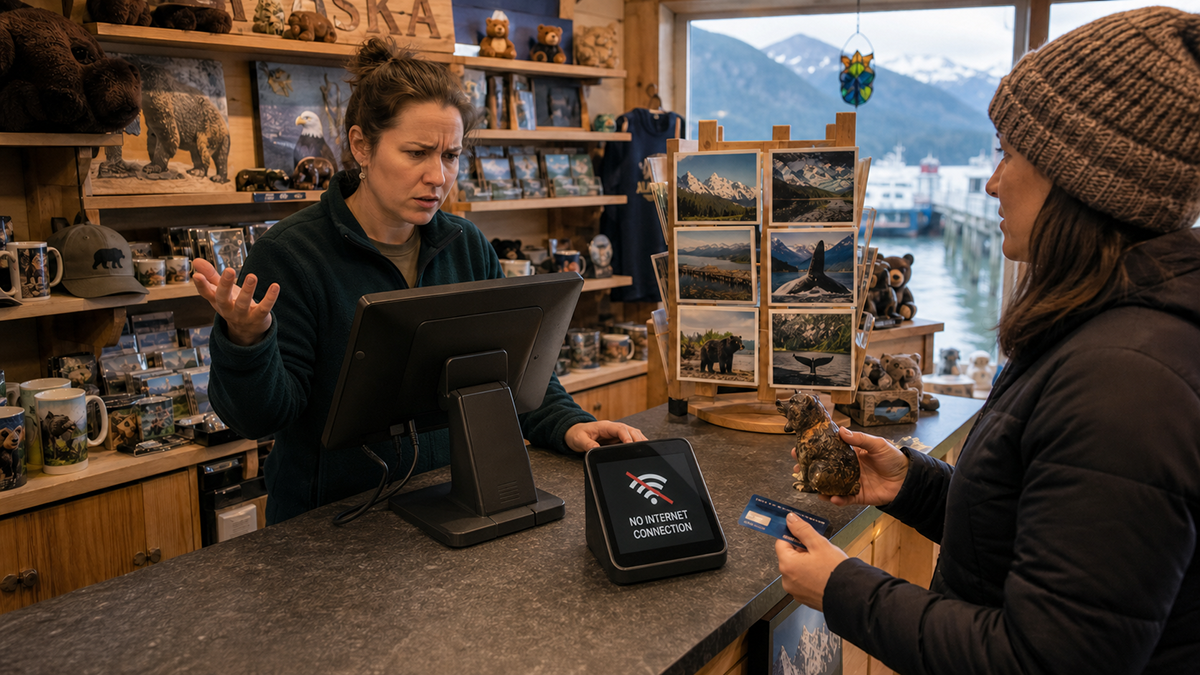
What’s actually at stake:
- Lost transactions. Every sale that can’t be processed during an outage is revenue that may not come back because customers in a hurry often just leave.
- Reputation damage. A system failure in front of a full house of customers is the kind of thing that ends up in reviews and word-of-mouth, especially in tourist-driven local economies.
- Missed bookings and inquiries. If your reservation system or phones are down, prospective customers often just move on to the next option instead of waiting.
- Staff inefficiency. Employees standing around unable to do their jobs during your busiest hours is a hidden cost that adds up fast.
- Data risk. Depending on the cause of the outage, there may be a real risk of data loss or corruption on top of the immediate disruption.
For seasonal or tourism-driven businesses across Southeast Alaska, the stakes are especially high. A bad afternoon during peak season can represent more lost revenue than an entire slow week in the off-season.
What a Business Continuity Plan Actually Covers
A real business continuity plan isn’t just “have a backup internet provider.” It’s a coordinated strategy covering your network, your data, and your team’s ability to keep functioning when something goes wrong.
A solid plan should include:
- Redundant internet connectivity, such as a secondary connection or failover system, so a single point of failure doesn’t take your whole business offline
- Reliable, tested data backups, so files, records, and systems can be restored quickly rather than lost or recreated from scratch
- A clear communication protocol for staff, so everyone knows exactly what to do and who to contact the moment something goes down
- Offline fallback procedures, especially for point-of-sale and customer transactions, so you’re not completely dead in the water during a short-term outage
- Proactive network monitoring, so many issues are caught and resolved before they ever become a customer-facing outage in the first place
The businesses that weather an outage with the least damage aren’t the ones who got lucky. They’re the ones who had a plan in place before they needed it.
Why This Matters Even More for Alaska Businesses
Running a business in Southeast Alaska comes with connectivity challenges that businesses in the Lower 48 rarely have to think about. Limited infrastructure, weather-related disruptions, and a smaller pool of local providers all mean outages can happen more often and take longer to resolve than businesses might expect.
Combine that with a tourism season that’s short, intense, and unforgiving of downtime, and the case for a real continuity plan becomes even more clear. A business that loses a few hours of connectivity during a slow month in Seattle has a very different problem than a business that loses a few hours during the height of Ketchikan’s cruise season.
How Computer Headquarters Helps Businesses Prepare
This is exactly the kind of problem we help local businesses get ahead of. As a Southeast Alaska-based IT provider, we understand both the technical side of building real redundancy and the local infrastructure realities that make Alaska businesses more vulnerable to outages than most.

Our approach to business continuity includes:
- Comprehensive IT management with proactive monitoring, so issues are caught before they become outages
- Secure, tested backup and cloud solutions, so your data is protected and recoverable no matter what happens
- Network security and infrastructure planning built around your specific business, whether that’s a retail storefront, a tour company, a healthcare provider, or a construction business
- Fast, local support when something does go wrong, instead of waiting on hold with a call center outside the state
We’ve spent years helping Southeast Alaska businesses, including healthcare providers, restaurants, and tour operators, build IT systems that hold up when it matters most, not just when things are running smoothly.
Don't Wait for Your Busiest Month to Find Out You're Not Ready

The businesses that get hit hardest by an internet outage aren’t the ones with bad luck. They’re the ones who never built a plan for it. If your systems go down during a slow week, it’s a hassle. If they go down during your busiest month, it’s a real hit to your revenue, your reputation, and your team’s ability to do their jobs.
The time to build a business continuity plan is before the busy season starts, not in the middle of it when the damage is already done.
Want to make sure your business can keep running no matter what happens to your connection? Contact Computer Headquarters today to build a business continuity plan built for Southeast Alaska.